


Important CDL Updates
Entry-Level Driver Training Requirement
Beginning February 7, 2022, entry-level drivers will be subject to the requirements in the Entry-Level Driver Training (ELDT) regulations. This includes drivers applying to:
- Obtain a Class A or Class B CDL for the first time;
- Upgrade an existing Class B CDL to a Class A CDL; or
- Obtain a school bus (S), passenger (P) or hazardous materials (H) endorsement for the first time.
The ELDT regulations establish a Federal standard for training CDL applicants. Applicants must successfully complete this training before they will be permitted to take the CDL skills test or, in the case of the H endorsement, the knowledge test. Drivers will search for a training provider using the upcoming Training Provider Registry. For more information, please visit the Entry-Level Driver Training (ELDT) webpage.
Human Trafficking Awareness Training Requirement
Effective July 12, 2021 District law (DCMR Title 18, Section 1303) requires all new drivers seeking a commercial learner permit (CLP) and those looking to convert an out-of-state CDL to complete mandatory Human Trafficking Awareness training before being issued a CLP or converting an out-of-state CDL.
The training involves watching a brief educational film and takes about 15 minutes to complete. The required training can be completed online and a printed certificate of completion will be issued upon successful completion of the online training.
Clearinghouse Status and CDL Downgrades
As established in the first Clearinghouse final rule, drivers with a “prohibited” Clearinghouse status are prohibited from operating a commercial motor vehicle (CMV) on public roads. The second Clearinghouse final rule (Clearinghouse-II) further supports this by ensuring that drivers with a “prohibited” Clearinghouse status do not continue to hold a commercial driver’s license (CDL) or commercial learner’s permit (CLP).
Beginning November 18, 2024, State Driver Licensing Agencies (SDLAs) will be required to remove the commercial driving privileges from the driver license of an individual subject to the CMV driving prohibition. This would result in a downgrade of the license until the driver completes the return-to-duty (RTD) process.
Note: SDLAs with legislative authority currently have the option to voluntarily query the Clearinghouse and downgrade CDLs for prohibited drivers and may do so before the November 18, 2024 compliance date.
Learn more about the second Clearinghouse final rule.
The Clearinghouse is a secure online database that gives employers, the Federal Motor Carrier Safety Administration (FMCSA), State Driver Licensing Agencies (SDLAs) and State law enforcement personnel real-time information about CDL and CLP holders’ drug and alcohol program violations.
The Clearinghouse contains records of violations of drug and alcohol prohibitions in 49 CFR Part 382, Subpart B, including positive drug or alcohol test results and test refusals. When a driver completes the RTD process and follow-up testing plan, this information is also recorded in the Clearinghouse.
For more information, please visit the Drug and Alcohol Clearinghouse website.
Non-domiciled Commercial Learner Permits (CLP) and Commercial Driver Licenses (CDL)
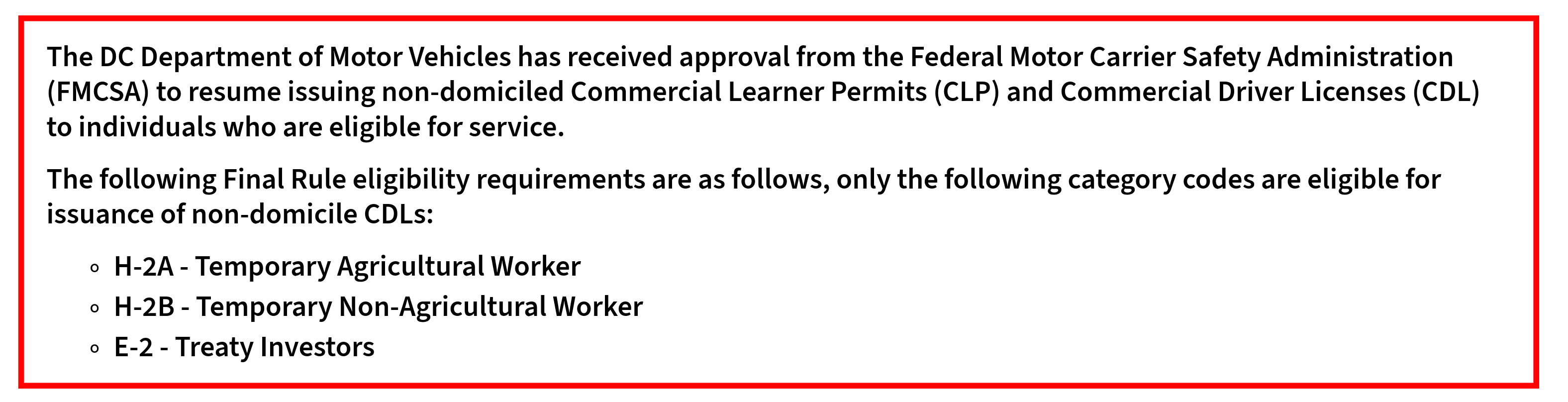
Eligibility Updates: Per the federal final rule effective March 16, 2026 (91 FR 7044), non-domiciled CDL eligibility is now restricted. Only the following category codes are eligible for issuance:
- H-2A - Temporary Agricultural Worker
- H-2B - Temporary Non-Agricultural Workers
- E-2 - Treaty Investors
Individuals eligible for a non-domiciled CLP or CDL are as follows:
Per Federal Regulation 383.71(b)(9), the person applying for a commercial driver's license must provide proof of citizenship or lawful permanent residency.
Applicants domiciled in a foreign jurisdiction (except Puerto Rico, the U.S. Virgin Islands, Guam, American Samoa, or the Commonwealth of the Northern Mariana Islands) must present evidence of a lawful immigration status. Evidence of lawful immigration status is only acceptable with the following:
- An unexpired foreign passport; and
- An unexpired Form I-94A/94A issued by the U.S Department of Homeland Security indicating one of the following classifications:
- H-2A Temporary Agricultural Workers
- H-2B Temporary Non-Agricultural Workers
- E-2 Treaty Investors
Applicants seeking a non-domiciled CLP/CDL must complete all transactions in person and provide required documentation, including an unexpired foreign passport and valid immigration documentation. Federal regulations limit eligibility to H-2A, H-2B, and E-2 specific nonimmigrant statuses and cap credential validity at one year.
No other immigration categories are eligible for a non-domiciled CLP or CDL under the final rule effective 3/16/2026 by FMCSA. Individuals excluded from eligibility include asylum seekers, asylees, refugees, and Deferred Action for Childhood Arrivals (DACA) recipients. Employment Authorization Documents (EAD) are no longer allowed to be accepted for issuance of a non-domiciled CLP/CDL.
For additional information, please see FMCSA’s FAQs.
The ABC's of Commercial Driving, Classes and Endorsements


Select an image above to download in PDF format.
Eligibility
DC DMV ensures the safety of commercial drivers through certain requirements for a CDL.
To get a DC DMV CDL, you must:
- Be at least 21 years old and have a valid NCDL.
- Note: To obtain an Intrastate CDL, you must be at least 18 years old. For information about the Intrastate CDL, please see: Intrastate CDL
- Be a US citizen or non-US citizen with a valid permanent resident card.
- Provide proof of US citizenship or lawful permanent residency.
- Provide a 10-year driver history report.
- Note: You will have to request this report from the department of motor vehicles in any state that has issued you a license in the past 10 years. DC DMV checks driving history in all 50 states.
- Have a Department of Transportation (DOT) medical certification completed by a Certified Medical Examiner listed on the National Registry of Certified Medical Examiners.
- Effective Monday, June 23, 2025, Certified Medical Examiners are required to electronically submit all CMV driver medical examination results through the Federal Motor Carrier Safety Administration’s (FMCSA) National Registry of Certified Medical Examiners (NR-II) Portal. DC DMV will no longer accept DOT medical cards from drivers after June 22, 2025.
Note: CDL learner permits may only have the following endorsements (with additional restrictions):
- S - School Bus
- N - Tank
- P - Passenger
You are not eligible to apply for a DC DMV CDL if you:
- Have a revoked or suspended NCDL.
- Have certain medical conditions, such as type 2 diabetes.
- Have a certain criminal felony conviction within the last three years (if you would like to work as a school bus driver).
- Have a scheduled hearing on moving violation ticket(s).
- Have an unresolved citation (such as tickets or judgment) in another jurisdiction.
- Are a non-US citizen who does not possess a valid permanent resident card
Upon issuance of a DC driver license or identification card, any driver license or identification card previously issued by another state will be cancelled. If a driver license or identification card is later issued to you by another state, your DC driver license or identification card will be cancelled.
Upon issuance of a DC driver license or identification card, any driver license or identification card previously issued by another state will be cancelled. If a driver license or identification card is later issued to you by another state, your DC driver license or identification card will be cancelled.
Documentation
To obtain a DC DMV CDL or first a CDL learner permit, you will need to bring the following documents when you take the CDL knowledge test(s):
- Valid DC DMV NCDL
- Note: If your current valid DC DMV NCDL is not a REAL ID license (a star in the upper right hand corner), you must also have proof of your social security number and two proofs of your residency in the District.
- Valid, unexpired US passport or certified birth certificate filed with a State Office of Vital Statistics or a Certificate of Naturalization or a Certificate of Citizenship—for US citizens
- Valid, unexpired permanent resident card—for non-US citizens
- Completed US Department of Transportation Medical Exam
- Effective Monday, June 23, 2025, Certified Medical Examiners are required to electronically submit all CMV driver medical examination results through the Federal Motor Carrier Safety Administration’s (FMCSA) National Registry of Certified Medical Examiners (NR-II) Portal. DC DMV will no longer accept DOT medical cards from drivers after June 22, 2025.
Note: Your driver record will contain medical information and DC DMV will send you a notification any time your medical information is updated.
Federal law requires CDL holders to submit a medical certification every two years. You must be examined by a medical professional listed on the National Registry of Certified Medical Examiners.